
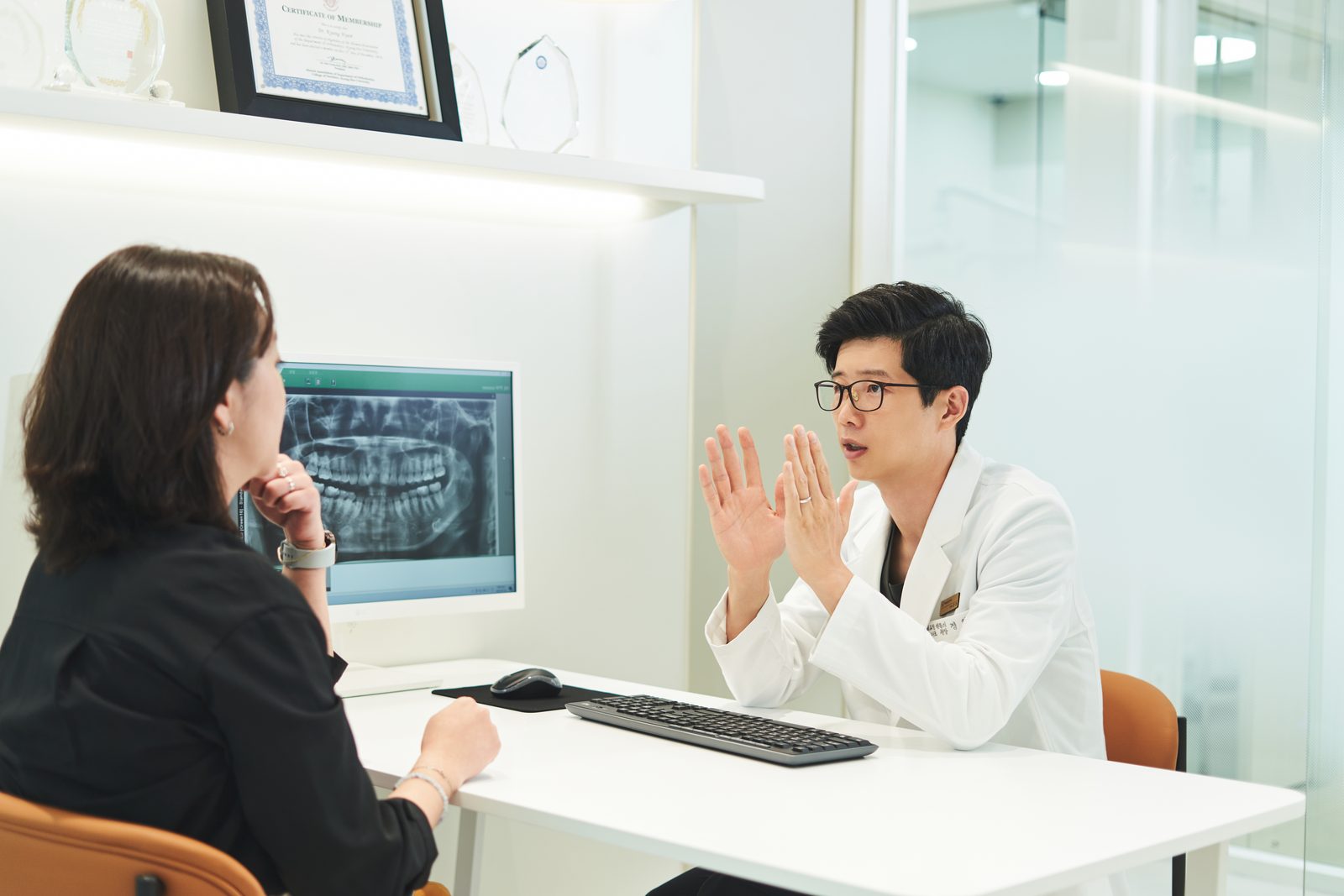
My jaw clicks and is hard to open. Do I need treatment now?
It depends on whether there is only a sound, or also pain, catching or limited opening. If your jaw clicks but does not hurt and opens fully, you often do not need an appliance right away; a diagnosis and monitoring are enough. If clicking comes with a catching feeling, pain when chewing, stiffness in the morning, or reduced opening for more than 2 to 3 weeks, it is better to start treatment.
If the jaw locks and cannot open (a disc that has slipped forward and does not return), the first week after it starts is the key window. During this time, manual therapy, physical therapy and a splint can return the disc more easily. If a lock released on its own, a diagnosis within 1 to 2 months is recommended.
How does a splint help?
A splint (occlusal stabilization appliance) is a thin, clear appliance worn between the upper and lower teeth, mainly during sleep. When you clench or grind, it absorbs and spreads the force on the joint and teeth, relaxes the chewing muscles and guides the jaw to a comfortable position. Wearing it once or twice a week is not enough; it needs to be worn every night.
Standard splint or Thermo splint?
| Standard splint (hard acrylic) | Thermo splint (newer material) | |
|---|---|---|
| Thickness and weight | Thicker and harder | Thinner and lighter |
| Getting used to it | May take time | Less bulky; most people adjust in 2 to 3 days |
| Fine adjustment | Possible by trimming or adding | Easy to fine-tune |
| Wearing again after a long break | Often needs to be remade | Often reusable after adjustment |
| Suitable for | Short, focused treatment | Long-term wear, relapse control, people sensitive to bulk |
| Fee (KRW, Aug 2026) | 690,000 | 890,000 |
Soft mouthguards may feel comfortable at first, but they can increase chewing muscle activity in people who grind and are hard to adjust, so they are not recommended for TMJ treatment. Ready-made mouthpieces bought online can also change the bite, so a custom-made splint is the standard.
How long is treatment, and how often do I visit?
Mild cases usually need about 6 months; more severe cases may need 1 to 2 years or longer. Stopping as soon as symptoms disappear often leads to relapse, so the end point is decided with the doctor after a period of maintenance wear. After the splint is delivered, fit is checked in 1 to 2 weeks, then the splint is adjusted about once a month. Wearing a splint for a long time without adjustment can change the bite, for example by creating a gap between the front teeth.
Can I have orthodontic treatment if my jaw joint is not stable?
Moving teeth on an unstable joint can temporarily unsettle the bite and make pain or limited opening worse. So the clinic evaluates the jaw joint first, and if it is unstable, stabilizes it before orthodontics. If there is only occasional clicking with no structural damage, orthodontics can proceed with monitoring. If there is limited opening, ongoing pain or findings on imaging, a splint is used first to find a stable jaw position, and the orthodontic plan is based on that position.
When are physical therapy and injections used?
The splint is the basis of treatment. Medication and physical therapy are added for acute pain or muscle tension. For ligament pain or strong clenching that does not respond enough, injections (prolotherapy with PDRN, or botulinum toxin) can be combined. The doctor decides what to use and when after the diagnosis. Listed fees (as of August 2026): botulinum toxin KRW 100,000, botulinum toxin for bruxism KRW 150,000, prolotherapy with PDRN KRW 200,000.
Daily habits that protect your progress
- Chew evenly on both sides.
- Cut down on hard, chewy food and on biting into large pieces.
- Support your chin with your hand when you yawn.
- Notice daytime clenching: keep your lips closed and your teeth slightly apart.
- Tell the doctor if morning jaw fatigue or headaches keep coming back.
At Bareun Face Orthodontic Clinic
At Bareun Face Orthodontic Clinic, the director is a board-certified orthodontist and a regular member of the Korean society for TMJ and occlusion (대한턱관절교합학회). The jaw joint and the bite are diagnosed together, and when needed, the joint is stabilized with a splint before orthodontic treatment is planned.
Frequently asked questions
- My jaw only clicks. Do I need treatment?
- If there is no pain or limited opening, you often do not need an appliance right away, but a diagnosis is recommended because the disc position may be changing.
- My jaw is locked and will not open. How soon should I come in?
- Within a week of it starting. Even if it released on its own, a diagnosis within 1 to 2 months can shorten treatment.
- How long do I need to wear a splint?
- About 6 months for mild cases and 1 to 2 years or more for severe cases, with adjustments about once a month.
- Is TMJ treatment covered by Korean health insurance?
- Examinations, some imaging and physical therapy may be covered for enrolled patients, but custom splints are mostly not covered.
- Can I bring a splint made at another clinic?
- Yes. Bring it in and the doctor will check whether it can be adjusted and worn again before considering a new one.