
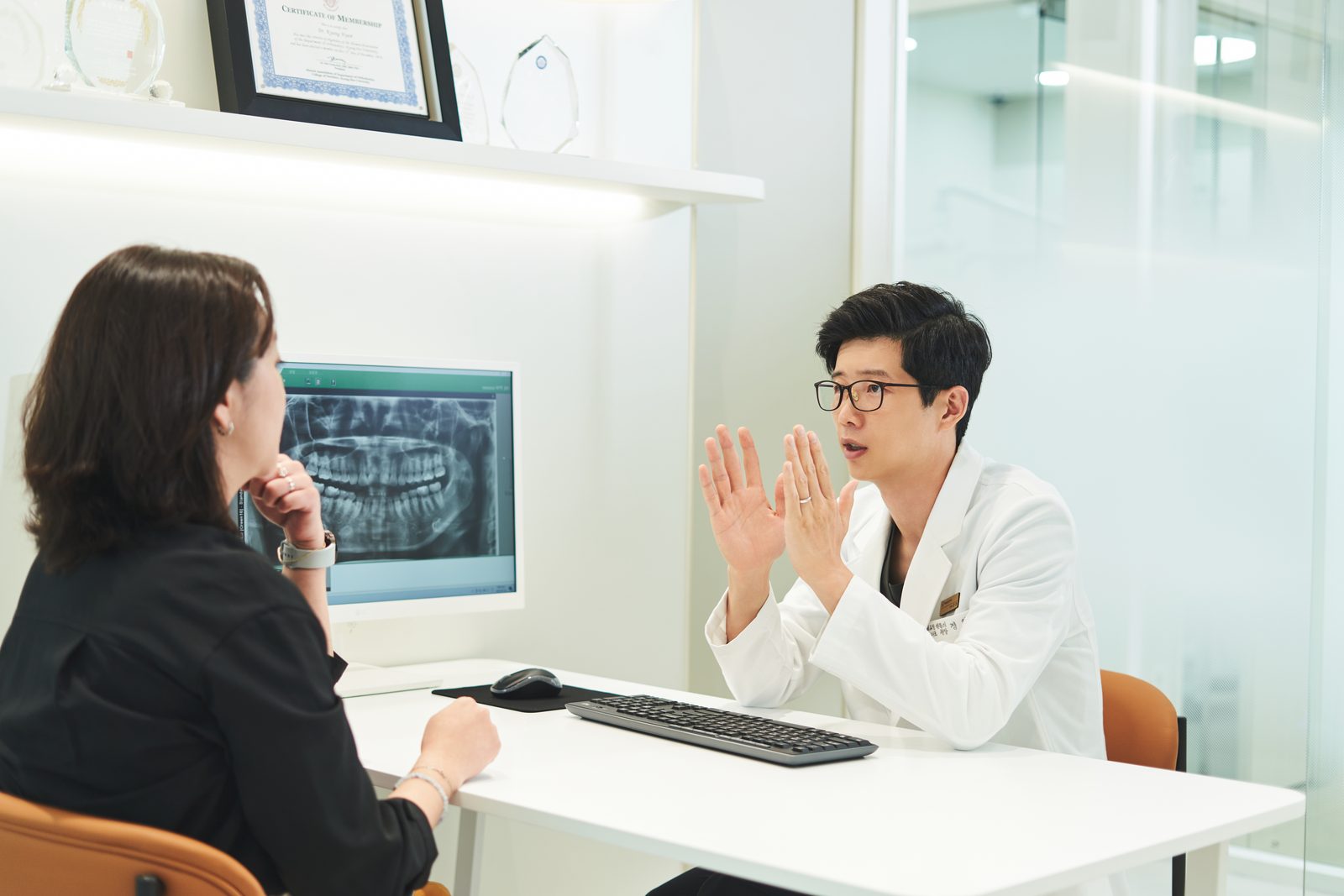
Where does orthodontic treatment start?
The same crooked tooth can have different causes. If the problem is tooth alignment, the plan is different from when the jaw size or position is the cause, and that changes the method, the duration and whether extraction is needed. At Bareun Face Orthodontic Clinic, the director, a board-certified orthodontist, analyzes your teeth, jawbone and airway with a 3D CT and an iTero Lumina scan (no impression material), then shows you the planned tooth movement as a 3D simulation before you decide.
Braces or clear aligners: what is the difference?
| Braces (metal, ceramic, self-ligating) | Clear aligners (Invisalign, Angel Aligner) | |
|---|---|---|
| Visibility | Visible (ceramic is less noticeable) | Hardly noticeable |
| Range of cases | Wide, including extraction cases and large rotations | Mild to moderate cases; complex cases possible with careful planning |
| Daily care | Fixed, so no wear-time worries | Results depend on 20 to 22 hours of daily wear |
| Visit interval | About every 4 to 6 weeks | About every 6 to 8 weeks |
| Eating and brushing | Food can get caught; brushing takes more effort | Remove to eat and brush |
Neither option is better for everyone. The right choice depends on how far the teeth need to move, how much appearance matters to you, and your daily habits. See the Invisalign page for details on clear aligners.
What are the steps of treatment?
- Examination: oral exam, 3D CT, intraoral scan, and evaluation of the face, bite and jaw joint
- Treatment plan: extraction or not, appliance choice and expected duration, explained with a simulation
- Appliance placement and tooth movement: visits every 4 to 6 weeks for braces, 6 to 8 weeks for aligners
- Finishing: fine adjustment of how the back teeth meet and how the front teeth overlap
- Retention: retainers and regular check-ups
Do I need to have teeth extracted?
Not necessarily. Extraction is one way to make space. When crowding is mild or moderate and the teeth do not protrude much, expanding the arch, slightly reshaping the sides of teeth (IPR) or moving the back teeth backward can create space instead. On the other hand, if the goal is to reduce protrusion, forcing a non-extraction plan can push the front teeth further forward. The doctor explains the pros and cons of both options while showing you the CT images. For growing children, early (phase 1) treatment that uses jaw growth may reduce the chance of extraction later.
How are pain, the jaw joint and cavities managed?
- Pain: the first 2 to 3 days after placing braces, changing a wire or switching aligners are usually the most uncomfortable. Most people find it manageable with over-the-counter pain relievers, though this varies.
- Jaw joint: if you have difficulty opening your mouth, or pain or clicking in front of the ear, TMJ stabilization comes first.
- Cavities and gums: food collects easily around appliances, so brushing is checked at each visit. Gum inflammation is treated before orthodontics starts.
Listed fees (as of August 2026)
Orthodontic treatment is generally not covered by Korean National Health Insurance, so these are out-of-pocket fees.
| Treatment | Fee (KRW) |
|---|---|
| Full braces, Standard (metal / A-line / S-line / Clarity Ultra) | 4,790,000 / 5,190,000 / 5,490,000 / 5,890,000 |
| Complex or Advanced difficulty | + 500,000 / + 1,500,000 |
| Full Invisalign | 5,990,000 to 7,990,000 |
| Partial braces (front teeth) | from 1,790,000 |
| Partial clear aligners (Angel Aligner) | from 2,190,000 |
| Children: Invisalign First / Angel Kid | 3,790,000 to 4,990,000 |
There is no separate monthly visit fee and no extra charge for mini-screws. Costs for impacted teeth, replacement retainers or lost appliances may apply depending on the case and are explained at the consultation. The final fee is confirmed after the examination. The full schedule is on the Korean fee page.
At Bareun Face Orthodontic Clinic
At Bareun Face Orthodontic Clinic, the board-certified orthodontist explains the reasons behind each decision, such as extraction or non-extraction and braces or aligners, using your CT and scan images. The same doctor continues through finishing and retainers, and all fees are explained before treatment begins.
Frequently asked questions
- How long does orthodontic treatment take?
- Full treatment usually takes 1.5 to 3 years, and front-teeth-only treatment about 6 to 12 months. The doctor gives you an expected range after the examination.
- Should I choose braces or clear aligners?
- It depends on how much the teeth need to move and on your daily habits. The orthodontist recommends options after the CT and scan.
- Will I need extractions?
- Not always. The decision is made after analyzing the space shortage, protrusion and jaw structure on a 3D CT.
- Is orthodontic treatment covered by Korean health insurance?
- Orthodontic treatment is generally not covered, so the listed fees are paid out of pocket. Ask at the clinic about any covered items such as examinations.
- How often do I need to visit?
- About every 4 to 6 weeks for braces and every 6 to 8 weeks for clear aligners.